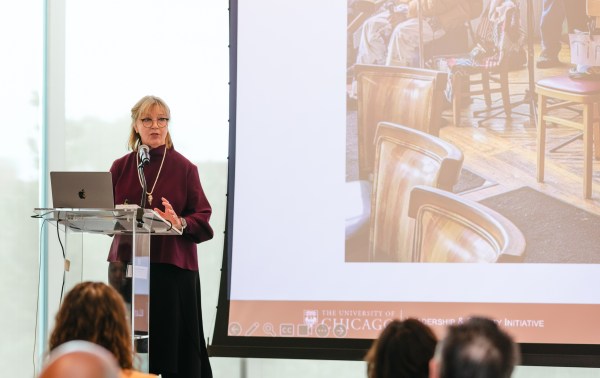
Accomplished Leaders Share Insights through Designing New Courses.
Share
Leadership and Society Initiative Fellows Pamela Narins, Justin Daab, and Laura Thrall are engaged in teaching as a meaningful way to extend their professional experience into a next chapter of purpose. Following their LSI fellowship years, they are now helping students engage big questions, connect theory with practice, develop leadership skills, and advance their impact.
Education is among the most powerful ways of making a lasting difference in society. A course has the potential to inform a student’s worldview and inspire their future, especially when the instructor brings a wealth of practical experience into the classroom.
Many University of Chicago Leadership and Society Initiative (LSI) Fellows identify teaching as a pathway to simultaneously contribute to society today and empower leaders to create positive change in years to come. Pamela Narins, Justin Daab, and Laura Thrall all began teaching to share the insights they’ve developed over decades of distinction while advancing their own goals of social impact and purpose-driven leadership.
Preparing for a new chapter
Pamela, Justin, and Laura became LSI Fellows to continue their lifelong journeys of discovery. Applying the lessons they learned over years of professional achievement, they took their engagement in an intellectual community to the next level by designing and teaching their own courses.
Pamela Narins
Pamela Narins is dedicated to promoting open, productive dialogue. As she strives to make an enduring impact in a purposeful next chapter, teaching is one important avenue for refining and sharing her ideas.
Before embarking on a career in advertising, Pamela earned her bachelor’s and master’s degrees in political science from UChicago. She applied the understanding of human motivation that she garnered from the social sciences to her work in executive roles at globally recognized agencies and as an independent consultant.
Pamela reached a professional crossroads at a time when she perceived political, social, and environmental crises everywhere in the world around her. As she contemplated how to apply her knowledge and abilities to make a difference in these overwhelming challenges, returning to UChicago to join the LSI community was a natural fit.
“The University has always been a place for me of true enrichment and delight,” she said.
With her academic background and longstanding interest in the power of persuasion, Pamela detected a through-line between her past endeavors and many of the concepts that arose in the multidisciplinary LSI curriculum. She decided to focus on identifying strategies for making conflicts more productive and less antagonistic.
“Disagreement does not only not have to be corrosive and toxic, but in fact, when handled productively, is a necessary prerequisite for civic flourishing,” Pamela said. “Every mode of human endeavor from the arts to politics to neuroscience to social science touches on this idea of disagreement and how we engage in it.”
Justin Daab
Justin Daab’s achievements as a leader in experience design and digital strategy are driven by his multifaceted creativity as well as an insatiable curiosity to understand technology and complex processes. He embraced teaching as an opportunity to pass along the insights he’s gained and help others reach their own objectives.
“Even when I owned a business for almost 30 years, working full-time, everyone always said, ‘Well, you’re going to teach, right?’,” he said. “All my life, I’ve generally been good at taking a really complex concept and breaking it down to fairly digestible morsels of data and themes.”
When Justin joined LSI, he knew that creating an educational curriculum would be part of his next chapter of purpose. His exploration resulted in teaching a course on Rapid Startup Design with AI in the Harris School of Public Policy in addition to leading a series of workshops for LSI Fellows seeking to define the goals and scope for their capstone project, the Next Chapter Roadmap.
“LSI does a really good job of giving you a broader understanding of the world than you came in with and conveying the philosophy that you’re not done learning,” Justin said.
Justin’s work in the classroom is one part of his broader vision for making a lasting impact in this phase of life. Drawing on concepts he developed in LSI, he co-founded Ampliflyer, which offers proprietary structured AI tools to speed decision-makers through the tasks of strategic research and analysis toward innovation.
Laura Thrall
Laura Thrall began teaching to impart to the next generation of leaders the lessons she’s learned from professional and personal journeys that have been defined by disruption and transformation.
In the past, she has served as CEO for four nonprofit organizations, ushering each through periods of dramatic change. Along the way, she had to rebuild her own mobility and communication following a ruptured brain aneurysm that occurred in 2011.
Laura has devoted her next chapter to expanding upon the kind of mentorship she provided to emerging nonprofit leaders throughout her years as a CEO. In LSI, she had the chance to reflect with support from a Next Chapter Advisor and draft a memoir that recounts her unique experiences.
“I was trying to think, how can I use my personal lessons in leadership, my life journey in trying to come back from a traumatic brain injury, and all I’ve done in change management from an organizational perspective to really enhance and imbue nonprofit leaders with tools and lessons that might be helpful,” Laura said.
Laura was invited to substitute teach a class of students who were enrolled in the Master’s in Public Policy/Social Sector Leadership and Nonprofit Management Dual Degree Program. Soon, she was invited to create her own course.
“There are a lot of things I’ve done throughout my career which I would consider teaching and helping to pull along the next generation of leaders,” Laura said. “So, I looked at the formal teaching as one part of that.”
Teaching Shaped by Leadership Experience
Pamela, Justin, and Laura built their courses around questions that had emerged from their own leadership journeys. Their professional experience gave them not only subject-matter expertise, but also a practical understanding of what is at stake when people navigate conflict, change, and responsibility.
Is the Leadership and Society Initiative Right for You?
Complete this self-reflective assessment to explore whether the UChicago Leadership and Society Initiative could be the right pathway into your next chapter of purpose.
Pamela’s course explored disagreement not as something to avoid, but as something that can deepen understanding when approached thoughtfully. Offered virtually through the UChicago Graham School, the course titled, “How Do We Disagree? Antigone and Twelve Angry Men,” invited adult learners to explore the dynamics of conflict and develop strategies for engaging more productively with people who hold different points of view.
Pamela focused the curriculum on two plays that present conflicts in the contexts of very different time periods and cultures:
The Ancient Greek playwright Sophocles wrote Antigone in the fifth century BCE, a tumultuous period of Athenian history. The tragedy’s protagonist is a young woman who places the familial duty to honor her late brother above her obligation to follow the laws of Thebes.
Twelve Angry Men, later adapted for the stage and big screen, began as a television play written by Reginald Rose and aired in 1954. The story of jurors at odds with one another over the verdict in a murder trial reflects the McCarthy era’s atmosphere of fear and paranoia.
“Both texts touch on the engagement of people who hold deeply seated, fundamentally held beliefs that are in opposition to one another and how they handle those disagreements,” Pamela said.
To establish an intellectual framework for the course, Pamela’s students first read the Kalven Report, a 1967 policy document issued by UChicago. The report, written by a faculty committee, is an influential statement on the principles of institutional neutrality, arguing for the importance of treating a university as a forum for free inquiry and debate.
Placing these texts in conversation allowed Pamela to demonstrate that voicing disagreement is not necessarily a matter of persuasion but can help people with distinct perspectives to understand each other. Her approach proved effective, and several students even asked to meet monthly to continue the conversation after the course concluded.
Can AI empower societal impact?
Justin leads one workshop per quarter, providing LSI Fellows with intellectual frameworks and technological resources to select and refine the plans that go into their Next Chapter Roadmaps.
“Having a first-hand understanding of Fellows’ anxieties and the program’s expectations, I had a really good idea for a generalized set of tools and processes that I know work,” Justin said.
Justin’s approach applies design thinking principles and leverages generative AI tools. In design thinking, leaders drive innovation and develop effective solutions by enacting systematic steps for ideation and implementation. According to Justin, the key to successfully applying a design thinking approach is empathy: setting aside one’s own biases to concentrate on serving the needs of the intended customer or client.
“I looked at how to train someone to have the proper perspective at various stages of design thinking,” he said. “To not try to promote their own agenda but to be selfless, open-minded, and ready to learn.”
Justin guides Fellows to define an area of focus and articulate a clear, realistic vision of how to make a meaningful contribution to society. An AI platform acts as a partner in Socratic dialogue, engaging each individual’s wisdom and challenging their biases to achieve an actionable and effective strategy with the greatest potential to serve real people.
“What I hope to convey to people in LSI is that your plan has to be sustainable for you as the human involved in designing your own life,” Justin said. “You may feel really passionate about a great idea that’s desired by the population you want to help, but when you look at what it will take to execute the idea, it might not be consonant with where you are at this point in your life. To have those examinations is really critical.”
How does disruption lead to transformation?
In Laura’s course, students examined how leaders can respond strategically and creatively when an organization faces change. She taught her course, “Disruption, Innovation, and Transformation in the Nonprofit Sector,” on campus as part of the Crown School master’s program in Social Sector Leadership and Nonprofit Management. The class of aspiring nonprofit leaders examined and discussed case studies to understand how a bold, strategic decision-maker responds to shifts in market forces, demographics, technology, and funding.
“I took four of my different experiences and said let’s focus on the disruption in each of these,” Laura said. “What were the external and internal forces? How did I use that to both embrace and transform the organization to something different?”
Drawing on the connections she’d forged throughout her career, Laura invited several nonprofit leaders to talk about their methods for managing disruption. The slate of guest speakers included:
Ellen Alberding, former CEO at The Joyce Foundation
Calaneet Balas, CEO at the ALS Association
Geoff DeLizzio, CAO at The Lieber Institute
Brandy Fureman, PhD, Chief Impact Officer at The Epilepsy Foundation of America
Sean Garrett, CEO at The United Way of Metropolitan Chicago
Larysa Kautz, CEO at Melwood, Inc.
Jody Olsen, PhD, former Director at The Peace Corps
Dorri McWhorter, CEO at The YMCA of Metropolitan Chicago
“I really enjoyed writing the curriculum,” Laura said. “It gave me a great foundation for workshops or other types of modules that I would do for different types of groups.”
Finding Your Path
Great teaching can transform students and instructors alike. For Pamela, Justin, and Laura, creating a course was a crucial step in pivoting from their longstanding careers into a next chapter of purposeful leadership and impact.
“LSI was fantastic, and I would recommend it to anyone who’s thinking about what they want to do,” Pamela said. “Being surrounded by the quality of my cohort and the staff who are there to inspire and support the program and the extraordinary richness of intellectual pursuit that the University offers; I never want to leave. Teaching was a delight and I’m grateful for the opportunity.”
By helping exceptional individuals like Pamela, Justin, and Laura to identify and pursue a next chapter of purpose, LSI acts as a catalyst for leadership in classrooms, organizations, and communities. Explore what LSI has to offer and engage with the alumni network to find out how this fellowship could shape your own leadership journey.
The University of Chicago Leadership and Society Initiative
The University of Chicago Leadership and Society Initiative (LSI) supports accomplished leaders in successfully transitioning from their longstanding careers toward purposeful next chapters. LSI Fellows immerse themselves in UChicago’s unparalleled environment of big ideas and multigenerational dialogue, gaining frameworks for learning from their past and planning for their futures.
Through LSI’s rigorous and customizable curriculum, Fellows engage with eminent faculty and expert practitioners to explore how their next chapter can be meaningful for them and for society. This Fellowship is a commitment to personal growth, enduring wellness, and dynamic engagement with pressing societal issues.
For Bob Oros, an experienced CEO and thought leader in the financial services industry, becoming an LSI Fellow meant entering a new life chapter with a sense of discovery instead of an ironclad plan.
With a career spanning technology, strategy, and innovation, Rénu reflects on how the Leadership and Society Initiative (LSI) fellowship is shaping her next chapter.